Cavendish or Baby Banana? Which Is Better for Kids?

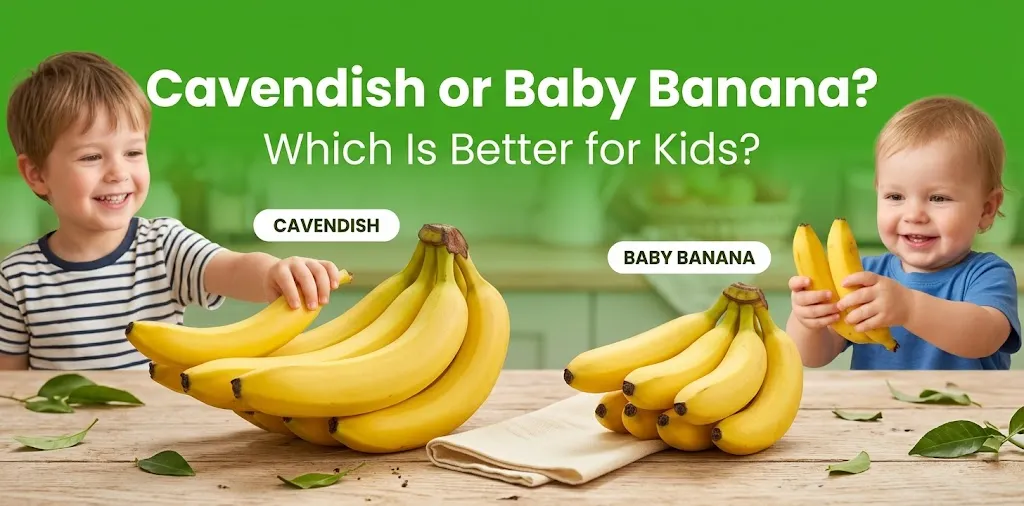
If you are choosing between Cavendish and baby bananas for kids, neither is automatically healthier. Both are whole fruits that can fit into a balanced diet. Cavendish bananas are larger, widely available, and easy to use for family snacks, while baby bananas are smaller and may be easier to portion for young children. The better choice depends mainly on your child’s age, appetite, texture preference, and how you plan to serve it.
Cavendish vs. Baby Banana for Kids
Cavendish is the standard banana most U.S. shoppers see at grocery stores. It has a mild flavor, soft texture when ripe, and is easy to mash, slice, or add to oatmeal and yogurt. Harvard’s Nutrition Source identifies Cavendish as the main banana variety sold in the U.S. and Europe.
Baby bananas are smaller varieties that are often sold as a snack-sized banana. They tend to have a sweet flavor and creamy texture when ripe. Their smaller size can make portioning simple, especially when a child does not need a full standard banana.
| Factor | Cavendish Banana | Baby Banana |
|---|---|---|
| Size | Larger | Smaller |
| Flavor | Mild and sweet | Often sweeter |
| Texture when ripe | Soft and creamy | Soft and creamy |
| Portion control | May need to be cut or partially served | Naturally smaller portion |
| Availability in U.S. stores | Very common | Less common |
| Good for snacks | Yes | Yes |
| Good for mashing | Excellent | Excellent |
| Best advantage | Easy to find and versatile | Convenient smaller serving |
The main nutritional difference is not as simple as saying one variety is always better. Banana nutrition can vary with serving size and ripeness, so comparing equal amounts is more useful than comparing one whole banana with another.
Which Banana Is Better for Younger Kids?
For a young child, baby bananas can be convenient because their smaller size makes it easier to serve an age-appropriate amount. However, a Cavendish banana can work just as well when you offer an appropriate portion.
The American Academy of Pediatrics recommends serving bananas sliced lengthwise as part of toddler snacks. The CDC also lists bananas among fruits that can be offered to infants and toddlers as they progress to eating solid foods.
For children who are still learning to chew, the important issue is how the banana is prepared, not simply which variety you buy.
A ripe banana should be soft and easy to mash. Depending on the child’s developmental stage, parents can mash it or cut it into suitable small pieces rather than handing over a large piece.
Which Has Better Nutrition?
Both types can be nutritious choices because bananas provide carbohydrates, fiber, and minerals such as potassium.
For reference, one medium Cavendish-type banana weighing about 118 grams provides about 105 calories, 27 grams of carbohydrate, 3 grams of dietary fiber, and no added sugar.
Baby bananas are smaller, so eating one usually means consuming less food than eating a full medium Cavendish. That does not mean the baby banana is more nutritious. It mainly means the serving is smaller.
For kids, the overall diet matters more than choosing one banana variety. The CDC recommends offering children a variety of fruits and vegetables as part of a nutrient-dense diet.
Fiber and Potassium
Bananas are a useful source of dietary fiber and potassium. USDA guidance lists bananas among fruits that can help provide potassium, while whole fruits generally provide more fiber than fruit juice.
If your child likes bananas, there is no need to avoid Cavendish simply because another variety is marketed as a “baby” banana.
Natural Sugar
Bananas contain naturally occurring sugar, but they do not contain added sugar when eaten fresh.
That makes a plain banana different from a banana-flavored snack, sweetened cereal, or dessert. For everyday snacks, whole fruit is generally a better choice than foods with added sugar.
Which Is Easier for Kids to Eat?
This is where baby bananas can have a practical advantage.
A small banana may be a comfortable amount for a child with a small appetite. A whole Cavendish can be larger than a young child needs for one snack, so you can simply serve part of it and save the rest.
For example, a parent might give a small child several appropriately prepared pieces of a Cavendish instead of the entire banana. MedlinePlus specifically notes that snack portions should match a child’s size and gives half a banana as an example serving for a 2-year-old.
For an older child who is hungry after school, a larger portion of Cavendish may be more practical.
Which Banana Is Better for School Snacks?
Cavendish is usually the easier choice if availability and cost matter.
You can find Cavendish bananas in most U.S. grocery stores, and they are simple to pack as a whole fruit. Baby bananas can also work well, especially when a child prefers smaller portions.
A banana can also be paired with another food to make a more filling snack. The American Academy of Pediatrics recommends building balanced toddler snacks around combinations of food groups rather than relying on fruit alone for every snack.
Good combinations can include:
- Banana with plain yogurt
- Banana with oatmeal
- Banana slices with whole-grain toast
- Banana with another fruit
- Mashed banana mixed into unsweetened yogurt
For younger children, prepare all foods in forms that match their eating skills.
Cavendish or Baby Banana for Picky Eaters?
Baby bananas may win if your child is attracted to their smaller size or sweeter taste. But there is no need to insist on one variety.
Kids often need repeated opportunities to try different foods. CDC guidance encourages offering a variety of fruits and vegetables and allowing young children to choose among healthy options.
If your child refuses Cavendish but enjoys baby bananas, the baby banana can be the better practical choice because the child is actually willing to eat it.
On the other hand, if your child happily eats Cavendish, switching varieties is not necessary just for nutrition.
When Cavendish Is the Better Choice
Choose Cavendish when you want:
- A banana that is easy to find
- A larger serving for an older or hungrier child
- A versatile fruit for oatmeal, smoothies, and baking
- An affordable everyday fruit
- A banana that the whole family can share
Cavendish is particularly useful for families because one bunch can serve different people at different portion sizes.
When Baby Banana Is the Better Choice
Baby bananas may make more sense when you want:
- A naturally smaller serving
- A sweet snack for a child who prefers smaller fruits
- A convenient option for lunches or snacks
- A different banana variety for introducing food variety
- Less leftover fruit after serving a young child
The smaller size is a convenience advantage, not proof that baby bananas are nutritionally superior.
Two Practical Kid-Snack Examples
Example 1: Snack for a Younger Child
Suppose a young child wants fruit between meals. A parent could serve an appropriately prepared portion of ripe baby banana with plain yogurt.
The small banana can make portioning easier, while the yogurt adds another food group to the snack.
Example 2: After-School Snack
An older child may be hungrier after school. A portion of Cavendish banana with plain yogurt and whole-grain toast can make a more substantial snack.
The point is not that Cavendish is “better” than baby banana. The larger banana simply makes it easier to adjust the portion for a bigger appetite.
What Parents Should Pay Attention to
The banana variety is only one small part of a child’s diet. More important factors include variety, portion size, preparation, and the rest of the child’s meals and snacks.
For younger children, avoid serving food in forms that can increase choking risk. Head Start recommends cutting foods into small pieces and avoiding foods known to cause choking.
Also, do not assume that a product made with banana is automatically equivalent to whole fruit. Fresh banana has no added sugar, while packaged banana snacks may contain additional ingredients.
If your child has a medical condition or a specific dietary need, ask their pediatrician or a registered dietitian about the best food choices.
So, Which Is Better for Kids?
For most kids, Cavendish is the better everyday choice because it is widely available, versatile, and easy to portion. Baby bananas are an excellent alternative when a smaller banana is more convenient or your child prefers their taste and texture.
Nutrition alone does not give either variety a clear overall win. The best banana is usually the one your child enjoys and that you can serve in an age-appropriate portion.
Frequently Asked Questions
Are baby bananas healthier than Cavendish bananas for kids?
Not necessarily. Both are bananas and can provide fiber, carbohydrates, and minerals such as potassium. Serving size and the child’s overall diet matter more than choosing one variety.
Can toddlers eat Cavendish and baby bananas?
Yes, bananas can be part of a toddler’s diet when served in an appropriate form and portion. For toddlers, bananas can be sliced lengthwise or otherwise prepared according to their eating skills.
Which banana is better for a child’s snack?
Both can work well. Baby bananas may be easier for smaller portions, while Cavendish is usually easier to find and can be divided into an appropriate serving for the child.
The Bottom Line
Cavendish and baby bananas can both be good choices for kids. Pick Cavendish for convenience and versatility, or choose baby bananas when their smaller size makes serving easier. The practical tip is to focus less on the banana’s name and more on serving a ripe banana in an age-appropriate portion alongside a varied diet.