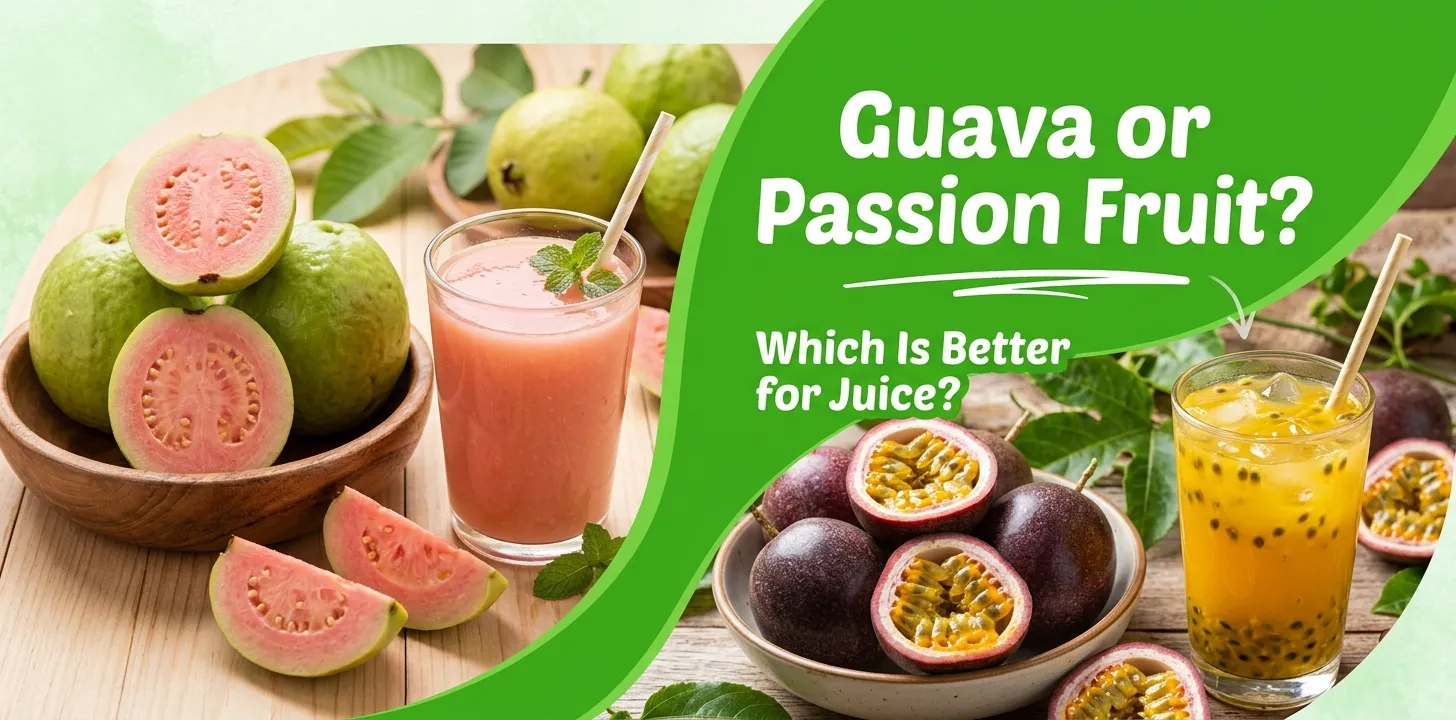
Guava or Passion Fruit? Which Is Better for Juice?

If you want a thick, smooth, naturally sweet juice, guava is usually the better choice. If you prefer a bright, tangy, highly aromatic drink, passion fruit has the edge. Guava gives more body and a mellow tropical flavor, while passion fruit delivers a sharper sweet-tart taste and works especially well when strained or blended with other juices.
The better fruit depends less on nutrition alone and more on the kind of juice you want to make. Guava and passion fruit behave very differently when blended, strained, sweetened, and mixed with other fruits.
Guava vs. Passion Fruit for Juice
| Factor | Guava | Passion Fruit |
|---|---|---|
| Flavor | Sweet, fruity, mildly tart | Strong, sweet-tart, aromatic |
| Juice texture | Thick and pulpy | Thin to medium after straining |
| Aroma | Mild to moderate | Very strong and distinctive |
| Acidity | Usually moderate | Noticeably high |
| Seeds | Hard seeds usually strained out | Small seeds can be eaten or strained |
| Natural sweetness | Generally sweeter and fuller | Tart with some natural sweetness |
| Best for | Smooth, filling juice | Refreshing tropical drinks |
| Blending | Excellent | Excellent, but often needs dilution |
| Straining | Often helpful | Usually preferred for smooth juice |
| Mixing with other fruits | Easy | Excellent with citrus and tropical fruits |
| Overall choice | Best for thick, mellow juice | Best for bold, tangy juice |
Flavor: Guava Is Mellow, Passion Fruit Is Bold
The biggest difference is flavor.
Ripe guava has a sweet tropical taste that can range from mild and pear-like to strongly fragrant and almost strawberry-like, depending on the variety and ripeness. It usually produces a juice with a rounded flavor rather than a sharp acidic bite.
Passion fruit is much more intense. Its pulp has a distinct sweet-tart flavor and strong aroma, with notes that can remind you of citrus and other tropical fruits. The University of Florida describes passion fruit pulp as strongly aromatic and tangy, while yellow varieties tend to be more acidic and are often favored for processing.
That difference matters when choosing a juice.
Choose guava if you want:
- A sweeter, softer fruit flavor
- A thicker drink
- A juice that is easy to enjoy on its own
- A less sharp acidic taste
Choose passion fruit if you want:
- A strong tropical aroma
- More tartness
- A refreshing drink with a sharp flavor
- A fruit juice that stands out in mixed drinks
Which Makes Better Juice Texture?
Guava generally produces the thicker juice.
The flesh breaks down into a substantial pulp, which gives the drink body. However, guava has many small, hard seeds. Blending them too aggressively can create a gritty texture, so straining the blended pulp is often worthwhile.
Passion fruit has a completely different structure. Its juicy pulp surrounds many small edible seeds. You can use the pulp and seeds together, but if you want smooth juice, you can press the pulp through a fine strainer to separate the seeds.
For a smooth glass of juice:
Guava: blend → strain → dilute as needed.
Passion fruit: scoop pulp → strain → dilute as needed.
Neither fruit needs complicated equipment, but both benefit from straining when a smooth texture is your priority.
Which Is Sweeter?
Guava is usually the better choice when you want a naturally sweet-tasting juice.
A ripe guava can have enough sweetness that you may need little or no added sweetener. The exact flavor depends on the variety and how ripe the fruit is.
Passion fruit is more acidic and tart. Even when ripe, its flavor has a noticeable sour edge. That’s one reason passion fruit juice is often diluted or combined with another fruit.
This doesn’t make passion fruit worse. In fact, the acidity can make a drink taste more refreshing.
For example, if you’re making juice for a hot summer afternoon, the sharpness of passion fruit can be more appealing than a thick, sweet guava drink.
Which Is More Refreshing?
Passion fruit usually wins for refreshment.
Its acidity and strong aroma give the juice a bright flavor. A little passion fruit can also change the character of a larger batch of juice because its flavor is so concentrated.
Guava juice is refreshing too, but it tends to feel fuller and heavier because of its pulp.
Think of the difference this way:
- Guava: smooth, fruity, filling
- Passion fruit: bright, tart, aromatic
If you’re looking for a breakfast-style fruit drink, guava can be a great fit. If you’re looking for something sharp and refreshing, passion fruit may be the better pick.
Which Has Better Nutrition for Juice?
Both fruits provide useful nutrients, but there is an important distinction between whole fruit and juice.
Guava is well known for its vitamin C content and also provides fiber, vitamins, minerals, and various plant compounds. A recent review of guava research describes the fruit as a source of vitamin C and other nutrients and bioactive compounds.
Passion fruit also contains vitamin C and other nutrients, including potassium and dietary fiber. Its pulp contains various plant compounds, and research reviews have examined its polyphenols, carotenoids, and other components.
However, juicing can change the nutritional profile because some of the fruit’s fiber and pulp may be removed during straining.
So, if nutrition is your main reason for choosing between them, don’t assume that a strained juice is nutritionally identical to eating the whole fruit.
Which Is Easier to Make at Home?
Guava is usually easier if you already have ripe fruit and a blender.
Wash the guava, cut it into pieces, blend it with water, and strain the mixture to remove the hard seeds. You can then adjust the thickness and sweetness.
Passion fruit is also simple, but you need several fruits to collect enough pulp for a larger glass of juice. The pulp can be strained if you don’t want the seeds.
Passion fruit’s strong flavor is an advantage here: you don’t necessarily need a large amount of pulp to give a drink a noticeable passion fruit taste.
Which Is Better for a Family-Size Batch?
For a larger batch, guava is often the more practical choice if you want a thick fruit drink.
Its pulp gives the juice more body, and you can adjust the consistency by adding water. If the guava is naturally sweet and ripe, you may also need less added sweetener.
Passion fruit is excellent when you want to flavor a larger amount of water or another juice. Its strong taste can work particularly well as part of a blend.
For example, a hypothetical family pitcher could use passion fruit with orange or pineapple juice. The passion fruit provides acidity and aroma, while the other juice supplies volume and sweetness.
Which Is Better for Mixing With Other Fruits?
Both are excellent, but passion fruit is especially useful when you want to add acidity and aroma.
Guava juice pairings
Guava works well with:
- Pineapple
- Mango
- Strawberry
- Orange
- Lime
- Apple
Because guava has a softer flavor, it can form the main base of a mixed juice.
Passion fruit juice pairings
Passion fruit works particularly well with:
- Orange
- Pineapple
- Mango
- Lemon
- Lime
- Guava
Its strong sweet-tart flavor can brighten fruits that taste very sweet or mild.
A guava-and-passion-fruit combination is also worth trying. Guava supplies body and sweetness, while passion fruit adds acidity and aroma.
Which Is Better for a Smoothie?
If your goal changes from juice to smoothie, guava becomes even more appealing.
Guava’s pulp helps create a thicker texture. You can blend it with yogurt, milk, ice, banana, or other fruit.
Passion fruit can add excellent flavor to smoothies, but its seeds can create a crunchy texture unless the pulp is strained first.
For a smooth smoothie:
Guava: better for body and thickness.
Passion fruit: better as a strong flavor booster.
You can also strain passion fruit first and then add the juice to a guava smoothie.
What About the Seeds?
Seeds are one of the main practical differences between these fruits.
Guava seeds are small but relatively hard. If you blend them heavily, they can make the finished drink unpleasantly gritty. Straining is therefore common when making smooth guava juice.
Passion fruit seeds are edible and are often eaten with the pulp. If you prefer a smooth drink, however, you can strain them out.
Research on passion fruit juice processing has also found that processing with seeds can affect properties such as viscosity and chemical stability, which helps explain why juice makers may handle the seeds differently depending on the desired product.
Which Fruit Gives More Juice?
This depends heavily on the variety, ripeness, fruit size, and how the juice is processed.
Passion fruit has a thick outer peel and a relatively small edible interior. The University of Florida notes that passion fruit processing can produce substantial waste because much of the raw fruit consists of peel.
Guava generally gives you more usable flesh from each fruit, although its seeds and pulp can make straining necessary.
If your priority is simply getting a large amount of drink from the fruit you buy, guava can be more practical. If your priority is intense flavor, passion fruit can deliver more flavor per amount of pulp used.
Two Practical Juice Scenarios
If you’re making a sweet breakfast juice
Choose guava.
Use ripe guava, blend it with chilled water, and strain it if you want a smoother texture. If the fruit is already sweet, taste the juice before adding any sweetener.
The result should be thicker, mellow, and fruit-forward.
If you’re making a refreshing afternoon drink
Choose passion fruit.
Strain the pulp, mix the juice with cold water, and adjust the sweetness to balance its tartness. You can also combine it with orange or pineapple juice.
The result will have a much brighter aroma and sharper tropical flavor.
Guava or Passion Fruit: Which One Should You Choose?
The simplest answer is to choose based on the drink you want.
| If you want… | Better choice |
|---|---|
| Thick juice | Guava |
| Smooth, mellow flavor | Guava |
| Naturally sweet-tasting juice | Guava |
| A filling fruit drink | Guava |
| Strong aroma | Passion fruit |
| Sweet-tart flavor | Passion fruit |
| A very refreshing drink | Passion fruit |
| A flavor booster for mixed juice | Passion fruit |
| Easy fruit combinations | Both |
| A balanced tropical blend | Guava + passion fruit |
The Best Overall Choice
For most people making juice at home, guava is the better all-around choice because it gives you sweetness, body, and a mild tropical flavor that works well on its own.
But passion fruit is the better choice when flavor intensity matters more. Its sweet-tart taste and strong aroma make it excellent for refreshing drinks and fruit blends. Yellow passion fruit, in particular, is commonly used for processing because of its acidity and yield characteristics.
If you can’t decide, combine them. Guava can provide the base while passion fruit adds the bright acidity and aroma that the guava lacks.
Frequently Asked Questions
Is guava juice sweeter than passion fruit juice?
Usually, yes. Ripe guava tends to have a sweeter, softer flavor, while passion fruit has a stronger sweet-tart character. The exact sweetness depends on the fruit variety and ripeness.
Can you mix guava and passion fruit juice?
Yes. They complement each other well. Guava provides body and a mellow sweetness, while passion fruit adds acidity and a strong tropical aroma.
Should passion fruit seeds be removed when making juice?
You can leave them in, since passion fruit seeds are edible, but straining produces smoother juice. If you want a clear or seed-free drink, press the pulp through a fine strainer before mixing it with water or other juice.
Final Verdict
Guava is better for thick, sweet, smooth-tasting juice, while passion fruit is better for bold, tangy, aromatic juice. Neither is universally better—the right choice depends on the flavor and texture you want.
For a first homemade batch, start with ripe guava if you prefer a mellow drink. If you like sharper tropical flavors, try passion fruit. And for the best of both styles, blend guava with a smaller amount of passion fruit.